
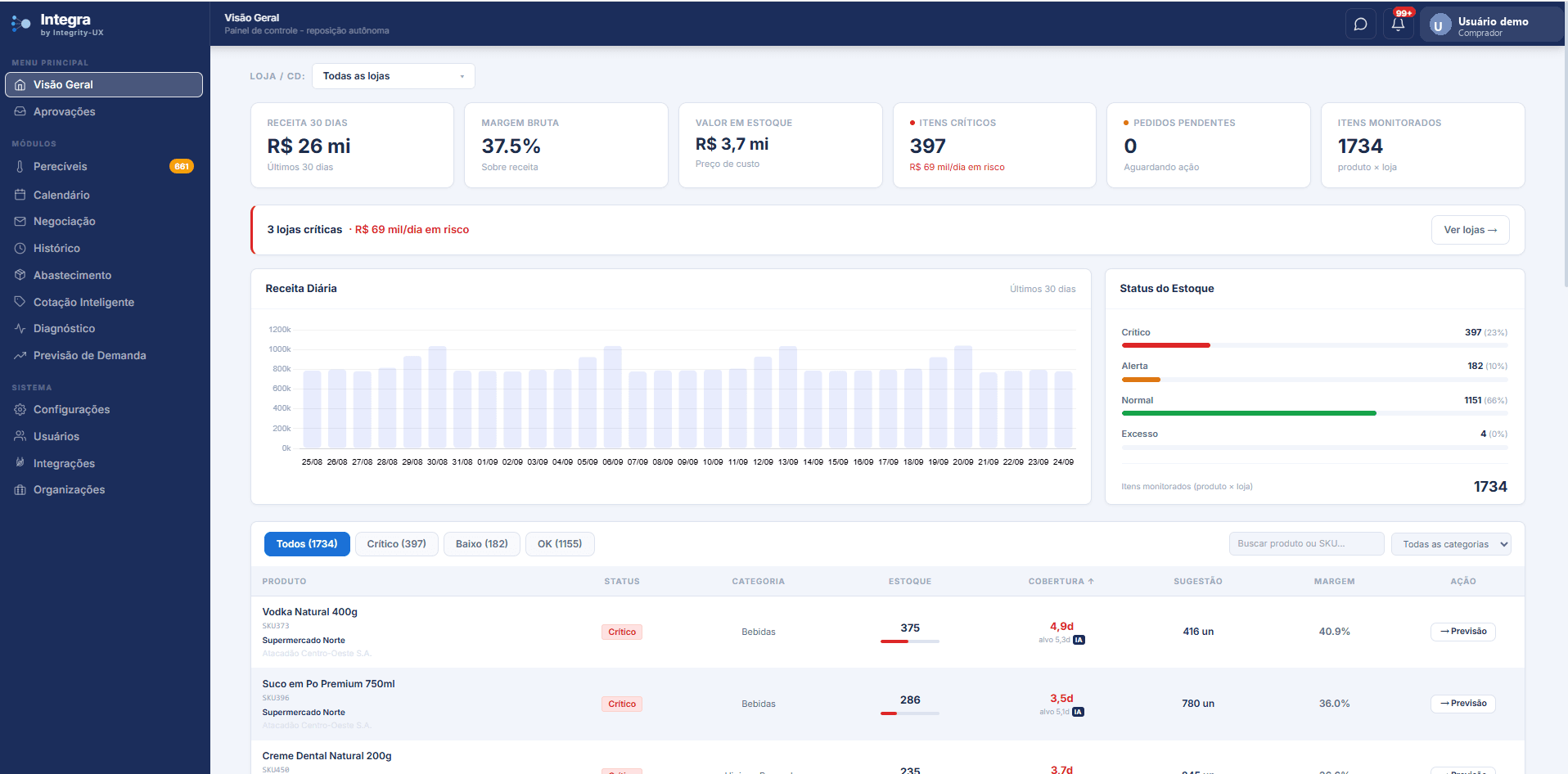
AI-driven autonomous replenishment for grocery retail
INTEGRA anticipates out-of-stocks before they reach the shelf, item by item and store by store, and recommends replenishment at the right moment. It works on the data the chain already generates, without replacing the ERP.
The inventory your system shows is a snapshot of the present. An out-of-stock is a future problem, and that is the gap where INTEGRA operates.

Why measuring out-of-stocks is not enough
Most chains already measure out-of-stocks, set targets and hold the team accountable. The problem is not the absence of an indicator, it is its timing: by the time the alert arrives, the sale is already lost. The buyer spends the day chasing a number from the past.
In-store out-of-stocks in Brazil moved 2.4 points in five months, from 13.2% in February to 10.8% in July 2026. This is not a stable level that can be offset in the product master, it is a target that shifts every month.
- 10.8% was the out-of-stock rate in Brazilian physical stores in July 2026, according to the Neogrid Out-of-Stock Index
- 8.3% is the worldwide average out-of-stock rate, measured in the Gruen and Corsten study for the GMA
- 25% of out-of-stocks occur with the product already inside the store, off the shelf
- 4% to 8% of revenue is what out-of-stocks consume, according to ECR Brasil
- 58% of shoppers stop buying and stop returning to the store, according to GS1 Brasil, 2025
- US$ 1.2 trillion per year is the global cost of out-of-stocks, measured by IHL Group in 2026
The three types of shortage, and how each one is handled
Treating everything as one stockout is what makes the problem look unsolvable. Separated, each one has its own cause and solution.

Shelf-level out-of-stock
The product is in the distribution center or the back room and missing from the shelf. The system shows inventory, so no alert is generated. INTEGRA detects the divergence between expected and actual sales with positive inventory, and triggers internal replenishment.

Systemic out-of-stock
It depends on purchasing, and the ERP reorder point reacts too late. INTEGRA combines demand forecasting with each supplier actual lead time and calculates the purchase deadline looking forward, alerting the buyer days in advance.

Imbalance between stores
The product is already in the network and is not selling: it is in excess in one store and missing in another. INTEGRA sees inventory across the entire chain and recommends redistribution before buying again.
Start with your own numbers, before any sales conversation.
With three files any ERP can export, we return the items at zero in your chain, those that stopped selling while still showing inventory, and what that represents in margin. If the numbers make sense, INTEGRA runs for one month at no cost, in up to two stores.
Why is Integrity-UX your ideal partner?

Specialized team
Specialists responsible for planning and migrating highly complex environments, ensuring greater security for your data and applications.

Successful projects
There are more than 200 projects delivered offering complete and cost-reducing solutions for our customers. Always focused on the solution for the customer.

Mais de 15 anos no mercado
Desde outubro de 2010 cuidando de ambientes de missão crítica, no Brasil e no exterior. Experiência acumulada em migrações, recuperação de ambiente e operação contínua em empresas de médio e grande porte.

Microsoft Partner
Aqui você contará com a expertise de uma empresa que tem a Microsoft como parceira, com todo conhecimento nas soluções encontradas em Microsoft Azure.
Some companies that are with us


Frequently asked questions about INTEGRA
Integrity-UX autonomous replenishment platform with artificial intelligence, which predicts out-of-stock risk and recommends replenishment before the product runs out on the shelf.
No. It reads the data the ERP already exports and adds the forecasting layer. No system is replaced.
Product master with cost and price, inventory position by store and twelve months of sales history.
No. It builds the order suggestion and leaves it for approval, with an audit trail. The purchase decision remains with whoever signs it.
It is when the system shows inventory and the shelf is empty. Since everything appears correct to the ERP, no alert is generated. INTEGRA identifies it through the divergence between expected and actual sales with positive inventory.
Yes. After the initial assessment, the platform runs for one month at no cost in up to two stores, on the real data of the operation.
INTEGRA was designed for supermarket chains with multiple stores, where imbalance between units and the volume of SKUs make manual control unfeasible.
